🚆 A Different Sound in Mumbai's Local Trains
Mumbai mornings have a familiar rhythm. The rush begins at the station. People wait for the next local with their office bags, lunch boxes and phones in their hands. When the train arrives, everyone moves quickly. Some search for a place to sit, some stand near the doors, and others simply try to find a little space for themselves.
Inside the coach, everyone seems to be in their own world. Someone is checking WhatsApp, someone is scrolling through Instagram, someone is trying to catch up on sleep, while someone else is already thinking about the first meeting of the day.
The train starts moving. One station passes, then another.
And suddenly, in the middle of all this noise, you hear something unexpected.
Clap… clap… clap…
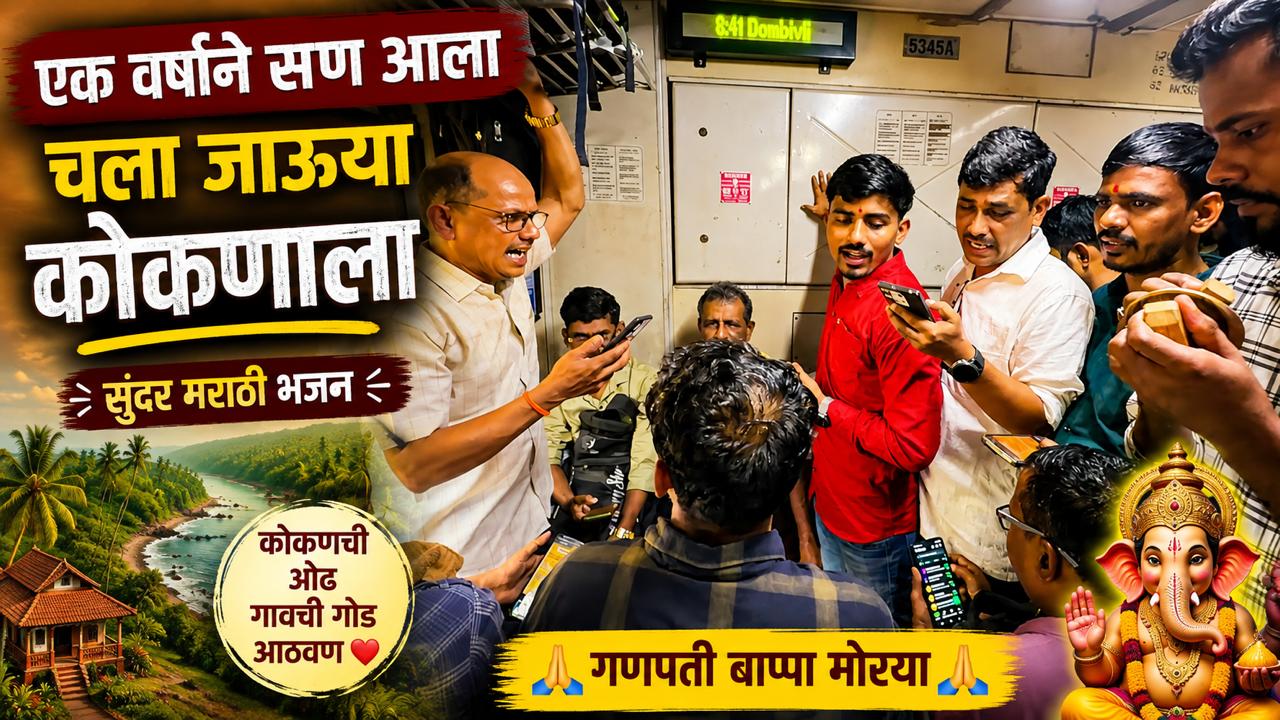
The sound of taal, traditional hand cymbals, begins. Someone starts singing an abhang. Another voice joins, then another. Within a few moments, a group of regular commuters is singing together.
There is no stage. There is no microphone. There is no ticket for the performance. There are simply a few people, their taal, devotional songs and a shared sense of faith.
The local train is still moving. Mumbai is still rushing outside the window. But inside that coach, the atmosphere feels completely different.
For a few moments, the train becomes a place of devotion, memory and togetherness.
🌴 A Tradition That Came From Home
The story of Mumbai's local train bhajan mandals is closely connected with the story of migration. For generations, people from the Konkan region have travelled to Mumbai in search of education, employment and better opportunities. They came from villages across Raigad, Ratnagiri, Sindhudurg and many other parts of Konkan.
They left behind their ancestral homes, village temples, courtyards, festivals, jatras and familiar faces. But they did not leave everything behind.
They carried their language. They carried their food. They carried their memories. And they carried their traditions.
In many Konkan villages, bhajan is more than a religious activity. It is a way for people to come together. People gather at temples during festivals and special occasions, sing abhangs, keep rhythm with taal and spend time together.
Children grow up listening to these songs. The older generation passes the tradition to the younger generation.
When many of these families moved to Mumbai, that tradition did not disappear.
It simply found a new place.
And for some commuters, that new place became the local train.
🎶 When the Local Train Becomes a Place of Bhajan
Imagine sitting in a crowded local train early in the morning. The train is moving quickly. Outside, buildings, roads and stations pass by. Inside, the familiar sound of taal begins.
Clap… clap… clap…
One person starts an abhang. The others respond. The rhythm becomes steady. Some passengers actively participate, some simply listen, some quietly move their hands to the rhythm, while others close their eyes for a few moments.
It may last only part of the journey. But those few minutes can completely change the mood of the morning.
For people travelling to work, the day usually begins with pressure. Traffic, deadlines, meetings, workload and competition are already waiting.
But when the bhajan begins, there is a small pause.
A pause from the rush.
A pause from the phone.
A pause from everyday worries.
Just a few minutes of peace inside one of the busiest cities in the world.
The beauty is that nobody needs a formal invitation to be part of the moment. Someone begins, and others naturally join in. A simple train journey slowly turns into a shared experience.
🙏 The Sound of Taal
There is something special about the sound of taal. It is simple, yet powerful. It does not require complicated instruments. One steady rhythm can bring an entire group together.
The sound of taal becomes the heartbeat of the bhajan.
Sometimes the singing is soft. Sometimes the group becomes more energetic. Sometimes everyone sings together. And sometimes, after an abhang ends, there is a short silence.
That silence can be just as meaningful.
For many regular commuters, this sound has become part of their daily routine. The day can feel slightly different when the familiar rhythm is missing.
“Something feels incomplete today.”
That is the power of a familiar tradition.
We often do not realize when something becomes part of our routine. We only notice its importance when it is suddenly absent.
❤️ More Than a Religious Activity
It would be easy to describe these bhajan mandals simply as religious groups. But for many people, they are much more than that.
They are communities.
People who travel together every day slowly become familiar with one another. They know who gets on at which station, who gets down where, which abhang someone likes and who usually carries the taal.
Over time, strangers become acquaintances. Acquaintances become friends. And sometimes, friends become like family.
Birthdays are remembered. Festivals are celebrated together. Someone's family function becomes an occasion for everyone to meet. If someone is unwell, others ask about them.
A daily train journey slowly creates a small community within the larger city.
Some relationships are not planned. They simply grow during the journey.
🥹 When Taal Brings the Village Back
For someone who grew up in a Konkan village, hearing an abhang in a Mumbai local can be an emotional experience.
The sound can bring back memories instantly.
A village temple.
A childhood courtyard.
A festival.
A family gathering.
An evening bhajan.
Grandparents sitting nearby.
The sound of taal.
The voices of people from the village.
Suddenly, the person is no longer thinking only about Mumbai.
For a few moments, the mind travels back home.
Back to the village.
Back to childhood.
Back to the people and places that shaped them.
That may be the most beautiful part of this tradition.
The local train takes people physically towards their workplace.
But the bhajan can take their minds somewhere else.
🌴 Konkan Lives Beyond Konkan
One of the most beautiful things about migration is that people may leave their hometown, but their culture travels with them.
Konkan is not limited to the geographical region between the Sahyadri mountains and the Arabian Sea.
Konkan also lives in the homes of people who have moved to Mumbai.
It lives in the food they cook.
It lives in the language they speak.
It lives in the festivals they celebrate.
It lives in the stories they tell their children.
And sometimes, it lives in the sound of taal inside a moving local train.
That is why these bhajan mandals are culturally significant. They show how a community can preserve its identity without physically recreating its village.
The city changes.
The surroundings change.
The lifestyle changes.
But certain traditions continue.
👵 A Tradition Passed From One Generation to Another
Many younger commuters may have grown up listening to bhajans at home, in their village or at a temple.
They may not have formally learned every abhang. Nobody may have sat down and taught them every line. They simply heard them repeatedly.
At home.
At the temple.
During festivals.
During family gatherings.
And eventually, the words became familiar.
This is how many traditional practices survive.
Not always through textbooks.
Not always through formal lessons.
But through observation, participation, repetition and the simple act of being present.
One generation sings. The next generation listens. And one day, the younger generation starts singing too.
That is how a tradition continues.
📱 Taal in the Age of Smartphones
Today's Mumbai local is very different from the local trains of previous generations.
Almost everyone has a smartphone. People watch videos, read messages, scroll through social media, listen to podcasts, check emails and sometimes even work during the journey.
The way people spend their travel time has changed dramatically.
And yet, in some coaches, the sound of taal continues.
That contrast is what makes these bhajan mandals so special.
Technology has changed the way we communicate. The city has changed. The generations have changed.
But the need for connection has not changed.
The need to pause has not changed.
The need to remember where we came from has not changed.
And perhaps that is why bhajan continues to find its place even in the middle of modern Mumbai.
No matter how much the screen changes our world, some things still connect us at heart.
🚆 A Different Kind of Journey
A local train normally has one purpose. It takes you from one station to another.
But for members of a bhajan mandal, the journey can mean something more.
It becomes a daily moment of togetherness. A familiar group. A familiar rhythm. A familiar song. A familiar face.
The train keeps moving. Stations keep passing. But for a few minutes, everyone is connected by the same rhythm.
Someone who entered the coach tired may leave feeling lighter. Someone who was thinking about a difficult day may find a moment of peace. Someone who has not visited their village for months may suddenly feel closer to home.
The destination may be the office, but the journey touches something much deeper.
🎉 When Festivals Bring Everyone Together
The relationship between these commuters does not always remain limited to the train.
Festivals can bring the group even closer. Ganesh Chaturthi and other religious or cultural occasions can become opportunities for the members to meet outside their regular journey.
People who see each other every morning may suddenly meet with their families. The same people who sing together in a local train may celebrate together outside it.
A simple daily journey slowly becomes a relationship filled with memories.
The local train brought them into the same coach, but bhajan brought them closer to one another.
🌿 A Few Minutes of Peace in Mumbai's Rush
Mumbai is famous for its speed. Everyone is going somewhere. Everyone has somewhere to be. The local train represents that speed perfectly.
But inside the same train, the bhajan creates a small pocket of calm.
For a few minutes, nobody needs to hurry. Nobody needs to compete. People simply sing, listen, keep rhythm and travel together.
Perhaps Mumbai needs more of these small moments of peace.
The bhajan does not solve anyone's problems. It does not reduce office work or remove daily responsibilities.
But it gives the mind a small moment of support.
And sometimes, that is enough to begin the day differently.
❤️ When the Bhajan Ends
Eventually, the destination approaches.
The familiar stations arrive. People begin preparing to get down. The taal becomes quiet. The abhang ends. The doors open and people step onto the platform.
Mumbai's rush begins again.
But something has changed.
Someone is carrying a little more peace into the day. Someone is remembering home. Someone is thinking about their village. Someone is quietly humming the same abhang.
The bhajan may have ended.
But the feeling remains.
Perhaps the same people will meet again the next morning. The taal will begin again. Another abhang will fill the coach. And for a few more minutes, another small pocket of peace will appear in the middle of Mumbai's rush.
🌴 The Living Connection Between Mumbai and Konkan
Mumbai and Konkan may look very different.
One is a fast-moving metropolitan city. The other is known for its green hills, beaches, villages and slower pace of life.
Yet the two are deeply connected.
Families have moved from villages to cities. People travel back home during festivals. Traditional food continues to be prepared in city homes. Ganesh Chaturthi brings people back to their villages. And bhajan mandals continue to bring the sound of Konkan into Mumbai's local trains.
This is the beautiful connection between Mumbai and Konkan.
Konkan does not live only in one geographical location.
It travels with people.
It travels through memories.
And sometimes, it travels inside a crowded local train.
🙏 A Tradition Worth Preserving
Cities are changing. Generations are changing. Entertainment is changing. Much of today's life happens through smartphones and digital platforms.
That makes preserving traditional cultural practices even more important.
Introducing children to traditional songs, supporting local cultural programs, encouraging bhajan mandals and listening to stories from older generations can help keep these traditions alive.
These may seem like small actions, but they matter.
Because traditions are not simply about the past.
They are part of the identity we pass on to the next generation.
One day, the abhang we hear today may be heard by a child. The taal we play today may be continued by someone from the next generation.
That is how culture remains alive.
💭 Have You Ever Heard a Bhajan in a Mumbai Local?
Now we want to hear from you.
Have you ever travelled in a Mumbai local where a bhajan mandal was singing?
Which railway line was it on? Which route? Between which stations? Do you remember which abhang they were singing?
Maybe you are a regular member of one of these bhajan mandals. Maybe your parents or grandparents were part of one. Or maybe you simply listened to the bhajan quietly while travelling to work.
Share your memory in the comments. ❤️
Your small story might remind someone else of the same local train, the same sound of taal or the same abhang.
And if your village has a special bhajan tradition, tell us about that too. Your story might even become the inspiration for another story about Konkan's cultural heritage.
🌴 The Sound of Taal That Carries Home
Mumbai's local trains will continue to run. Stations will continue to come and go. New passengers will enter. Others will step out. The city will continue to move at its incredible speed.
But as long as someone continues to carry their taal into that crowded coach, as long as someone starts an abhang, and as long as a few voices come together, one thing will remain alive—
The connection to our roots.
A village can be left behind. A home can be far away. But the voice of one's culture cannot easily be removed from the heart.
Sometimes, that voice brings us back to where we came from.
Through the sound of taal.
Mumbai may teach us how to survive and move forward, but an abhang and the rhythm of taal remind us where we came from.
Perhaps that is why the sound of taal in Mumbai's local trains is more than a bhajan… it is the sound of our village, our people and our roots. 🌴🚆❤️🙏